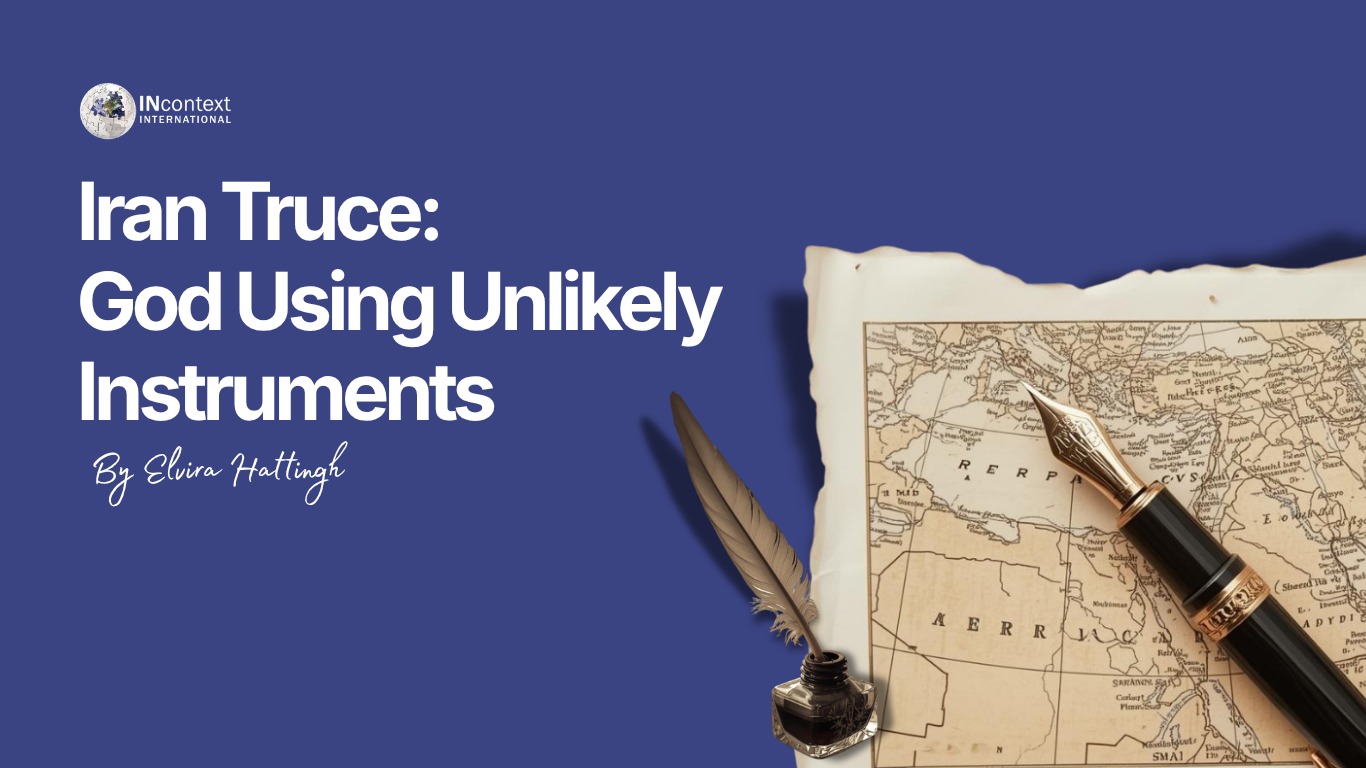
By Elvira Hattingh
The two-week ceasefire between the United States, Iran, and (partially) Israel, announced on 7 April after intense back-channel work, remains paper-thin. Violations have already been reported—fresh accusations of strikes on Lavan Island, drone activity over Gulf states, and Israel’s unrelenting campaign against Hezbollah in Lebanon. Trust between the parties is near zero. Yet this fragile pause is holding just long enough for direct US-Iran talks to reach their fifth day (as of 14 April 2026) in Islamabad, Pakistan.
However, Christians worldwide are not viewing this through a political lens alone, but rather see it as a sovereign act of God: a gentle reminder that God is still at work, bringing hope to the persecuted Church.
The fragile truce was born not from any amount of trust but from the threat of wider war—US strikes paused in exchange for Iran reopening the Strait of Hormuz. Oil prices have since dropped sharply (Brent crude immediately dropped to $98–$102 after earlier peaks of above $110), easing fuel costs. Shipping lanes are moving again, though cautiously. However, the ceasefire remains fragile, and reports of violations and mutual accusations continue, with only seven days left before the two-week truce expires on 21 April.
This very fragility reminds us that human agreements are temporary and that only God can bring lasting peace and security.
At the same time, God is using unlikely instruments in His plan: Pakistan—a nation whose own Christian minority endures blasphemy laws and mob violence—has emerged as the primary mediator. Drawing on decades of quiet diplomacy, Islamabad conveyed messages, co-drafted a five-point peace plan with China, and hosted the breakthrough framework that led to this ceasefire. Pakistan’s track record is impressive: it served as the back-channel for the 1971 US-China opening, played a key role in the 1988 Geneva Accords ending Soviet involvement in Afghanistan, and facilitated the 2020 US-Taliban talks that led to the Doha Agreement. Today, Prime Minister Shehbaz Sharif and Army Chief Field Marshal Asim Munir have turned that experience into a “reverse Bismarck” strategy, positioning Pakistan as a trusted bridge between Washington and Tehran.
China, too, has played a supportive role—co-sponsoring the 31 March five-point initiative calling for an immediate ceasefire, the protection of civilians and infrastructure, safe shipping through the Strait of Hormuz, and respect for sovereignty. Beijing’s economic leverage as a major buyer of Iranian oil helped nudge Tehran toward de-escalation. Christians worldwide grieve the ongoing, systematic restrictions that our brothers and sisters face in China through its “sinicisation” policy, which requires all religious groups to align with Communist Party ideology. Yet, we marvel at how the Lord can use even non-Christian powers as modern-day Cyrus figures to restrain conflict and open doors (Isaiah 45:1). Neither Islamabad nor Beijing is our hope—still, both are instruments in the hand of God who “turns the king’s heart wherever he wills” (Proverbs 21:1).
The Persecuted Church
At the heart of this stands the suffering Church. In Iran, the underground Church—already one of the fastest-growing in the world despite decades of persecution—reports an outpouring of spiritual hunger. Believers say the war has shaken people’s trust in the regime and turned hearts toward Jesus. Families gather in homes for prayer amid blackouts; young people ask bold questions about eternity. Christian teams are rushing Farsi Scriptures, trauma-healing resources, and emergency aid across reopened shipping routes. In Lebanon and Israel, Messianic and Arab Christian workers continue frontline relief and counselling amid ongoing strikes. The human cost has been immense—thousands dead, families displaced—yet testimonies of forgiveness and courage shine through.
This moment calls for a practical missionary response. The sharp drop in oil prices and the partial reopening of the Strait of Hormuz have lowered transport costs for scripture shipments, relief supplies, and mission teams. Believers around the world are already feeling relief at the fuel pump, freeing up resources that can be redirected to frontline work. Aid distribution and trauma care are being scaled up while this delicate window remains open.
However, this ceasefire is not the arrival of lasting peace; the Bible reminds us that only God’s return will wipe away every tear and make all things new. Christians, however, regard this as a God-given mercy—a wide-open Gospel door in the midst of chaos. History shows that war and crisis often precede revival.
Beyond immediate relief efforts, mission leaders stress the importance of strengthening local believers for the long term. Much of the growth of the Church in Iran and across the wider region is taking place through small house fellowships and informal discipleship networks rather than large public gatherings. Training materials, digital Scripture resources, and pastoral support are therefore becoming increasingly important. Ministries are working quietly to equip local believers with theological training, leadership development, and trauma counselling skills so that churches can care for their own communities even when international access is limited. In this way, the global Church is not only responding to a crisis but helping to build resilient Christian communities that can continue the work of the Gospel long after headlines have moved on.
In the meantime, the Church in the Middle East is not a victim of events—it serves as a lighthouse in the darkness, bringing real and tangible hope. As delegates continue their work in Pakistan, Christians worldwide are asked to pray. May the Lord find us faithful in this hour.
Prayer points
- Wisdom and restraint for negotiators in Islamabad, that the fragile ceasefire may hold and open the door to meaningful de-escalation.
- Protection and courage for the underground Church in Iran and believers serving in Lebanon, Israel, and the Gulf, and that the current spiritual openness will lead many to Christ.
- Provision for relief work, Scripture distribution, and discipleship efforts, as reopened shipping routes and lower costs create new opportunities for ministry.
Sources:
- Al Jazeera: “Nixon to Trump: Pakistan’s long record as backchannel between rival powers” (March 27, 2026) – https://www.aljazeera.com/news/2026/3/27/nixon-to-trump-pakistans-long-record-as-backchannel-between-rival-powers
- AP News: “Pakistan has emerged as a mediator between US and Iran” (March 27, 2026) – https://apnews.com/article/pakistan-us-iran-war-emerging-peace-mediator-f4e809dd3f93b3d67b54f9d75d33d55c
- BBC: “Iran war: How Pakistan became an unlikely mediator” (March 30, 2026) – https://www.bbc.com/news/articles/cy91vrzxn34o
- US State Department Historical Documents: China, 1969–1972 (on 1971 Pakistan back-channel) – https://history.state.gov/historicaldocuments/frus1969-76ve13/comp1
- Wikipedia / Foreign Affairs: Geneva Accords (1988) and Pakistan’s role – https://en.wikipedia.org/wiki/Geneva_Accords_(1988) and https://www.foreignaffairs.com/articles/asia/1988-06-01/afghanistan-accords
- Journal of South Asian Studies: “The Role of Pakistan in Facilitating Peace between the Taliban and the United States” (2025) – https://jssrp.org.pk/index.php/jssrp/article/view/89
- Reuters / Dawn / National Security Archive reports on Pakistan’s historical mediation (cross-referenced for 1971, 1988, 2020 events)
- On-the-ground partner reports from Iran, Lebanon, and Gulf teams (Global Harvest Missions internal updates, April 2026)
- Market data from Brent crude and shipping updates (April 8–14, 2026) via standard international energy reports.