By Elvira Hattingh
“When you found us, we had already made the prayer of those who are dying.”
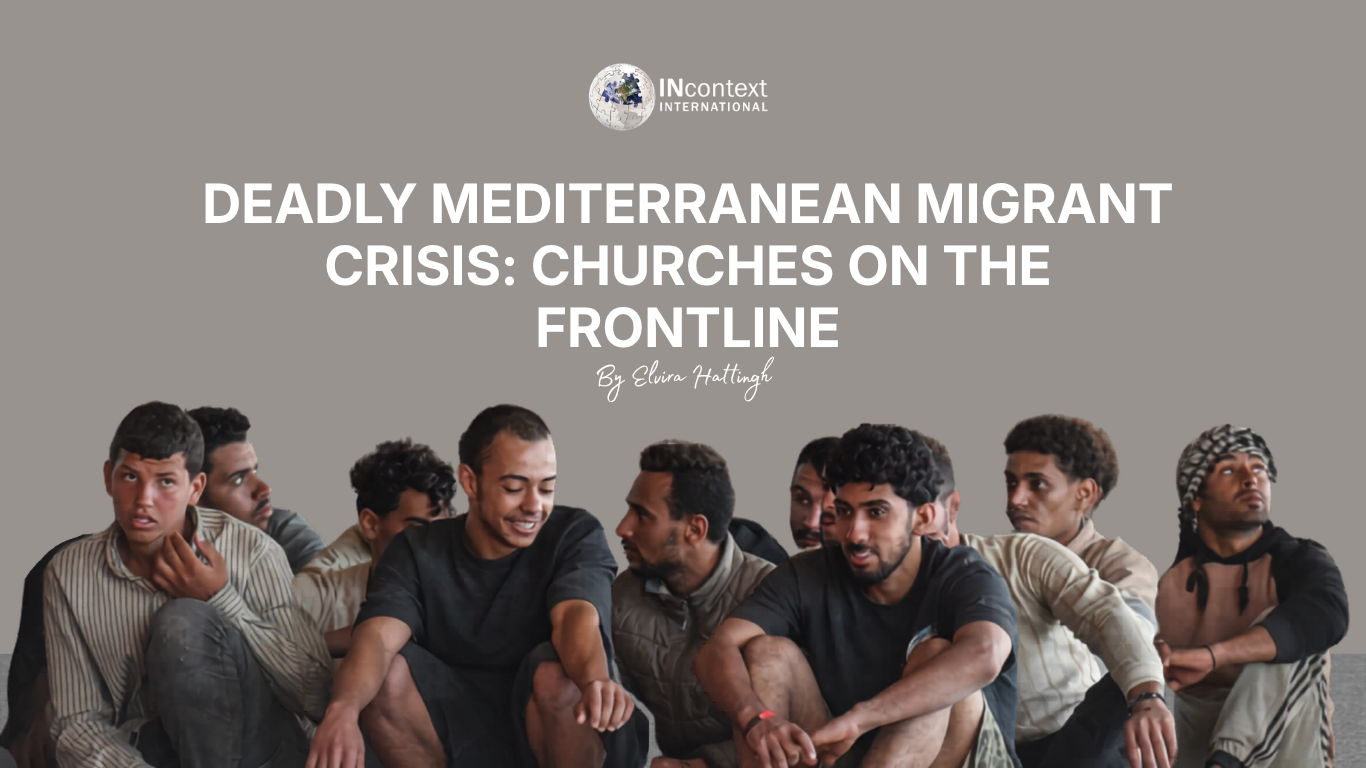
These are the words of Ayman*, a 28-year-old Egyptian man rescued in mid-April 2026 by the Ocean Viking, the rescue ship operated by SOS Mediterranee. He was one of thousands of migrants attempting the dangerous Mediterranean crossing in search of safety, work, education, or simply survival.
Following his father’s death, Ayman became responsible for supporting his wife, children, mother, and siblings. Despite working in a medicine factory in Egypt, he could not make ends meet and eventually travelled to Libya, hoping to earn enough money to support his family.
Instead, smugglers took him to what he described as a “sort of prison” and demanded far more money than initially agreed. Ayman spent six months in Libyan detention centres run by smugglers. During that time, he was beaten, tortured, and extorted while his family back home sold everything they owned to pay ransom demands.
“I was kept in a place with many other people,” Ayman remembers, “and I saw no daylight for six months. We were barely fed, and we were given salty water to drink.”
When the money ran out, the smugglers forced them onto an overcrowded boat at gunpoint. “When we were brought to the beach, we had to swim to the boat, with water up to our necks. The weather was very bad, with big waves, and we were all terrified. I thought I would rather die at sea… We were cold and lost at sea and were sure we were going to die.”
During the crossing, the engine failed and the boat began taking on water in rough seas. Ayman believed everyone on board would die. He and his companions prayed what they thought would be their final prayer as waves crashed over the vessel and the cold intensified.
Instead, the passengers were rescued by the Ocean Viking. Ayman is now receiving medical and psychological care in Europe, although the trauma of the experience remains severe.
One of the Deadliest Starts on Record
According to the International Organization for Migration (IOM), at least 990 migrants had died or gone missing in the Mediterranean by early April 2026. It marks one of the deadliest starts to a year since the organisation began tracking migrant deaths in 2014.
The Central Mediterranean route, mainly between Libya or Tunisia and Italy, remains the most dangerous. Around 765 people had already perished there by early April — an increase of more than 150% compared to the same period in 2025. Many migrants are fleeing war, persecution, famine, or extreme poverty from sub-Saharan Africa, the Middle East, and other regions.
SOS Mediterranee reports that it has rescued more than 42,700 people since 2016. Among them are children travelling alone, families fleeing conflict, and young people trying to reach safety and education opportunities.
Another Sudanese survivor whose story illustrates the ongoing crisis is 18-year-old Yes from El-Fasher in Darfur, rescued in August 2025. “My dream is to become an engineer. I’ve had this dream since I was little, and I will fight for it; I will never give up,” he says.
Yes fled the brutal fighting and famine in Darfur, saying there was “no food and children dying of hunger” in his community. He was also tortured, forced into labour, and extorted in Libya before boarding a migrant boat with almost nothing.
“When somebody dies, it’s a normal thing there now, because there is no security people, just citizens by themselves. If I hadn’t run away, the Rapid Support Forces would have arrested me and forced me to be one of them.”
He says his actual goal was to find a way to help his family and pursue education. “I decided to find a way to solve the problems we face, my family and I. So I got the ambition that one day I will do my best to go to Europe to have basic education that will serve my future. What we are looking for is education. When somebody becomes well-educated, they will give a hand to society.”
Like many others making the crossing, he travelled on an overcrowded boat without life jackets while fearing constantly that it could capsize.
More Dangerous by the day
Although the number of Mediterranean crossings has declined in 2026, the journeys themselves have become significantly more dangerous. Italy, for example, recorded around 6,200 sea arrivals in early 2026, compared to about 9,400 during the same period in the previous year.
Despite the lower numbers, deaths have risen sharply due to increasingly dangerous conditions. Boats are often unseaworthy and overloaded, while fewer NGO rescue vessels remain active after detentions and operational restrictions. Aid organisations have also warned about “invisible shipwrecks”, where boats disappear entirely without distress calls ever being recorded.
In the 10 days leading up to April 7 alone, more than 180 people were feared dead or missing.
Southern European countries continue to bear the brunt of the crisis. Italy, especially islands such as Lampedusa and areas of Sicily, remains the primary landing point for many rescued migrants. Greece continues to experience deadly incidents along the Eastern Mediterranean route, while Spain’s Western Mediterranean route from Morocco and Algeria also remains dangerous.
Christians Responding on the Ground
Christian organisations and churches have become heavily involved in supporting migrants and refugees arriving from the Mediterranean.
One of the best-known examples is Mediterranean Hope, the refugee and migrant programme of the Federation of Evangelical Churches in Italy (FCEI), which represents Protestant churches including Waldensian, Methodist, Baptist, and Lutheran congregations.
The programme was launched in 2014 after major Mediterranean shipwrecks, specifically to respond to the crisis through practical assistance and Christian compassion.
Mediterranean Hope operates welcome centres and reception houses, particularly in Sicily, Lampedusa, and southern Italy. The organisation provides trauma counselling, medical care, legal assistance with asylum applications, Italian language classes, job training, and longer-term integration support.
It also helps operate humanitarian corridors that allow vulnerable people to travel safely to Italy on legal flights instead of attempting dangerous sea crossings. Through this ecumenical programme, thousands of people have reportedly reached Italy safely since 2015.
The work is funded primarily through church support, including the Waldensian “Otto per Mille” tax allocation and donations from churches in Italy and abroad.
Other Christian organisations are also active in responding to the crisis. The Community of Sant’Egidio, a Catholic lay movement, and Caritas, the Catholic Church’s official aid organisation, work closely with Mediterranean Hope.
Caritas operates reception centres in countries such as Italy, Greece, and Spain, and Sant’Egidio has also recently publicly called on Italy and Europe to strengthen sea rescue operations and expand safe migration routes.
In Greece, evangelical teams continue working on the islands, while churches in Spain assist people arriving along the Canary Islands route and mainland coastlines.
Across these regions, churches and Christian organisations have become part of the practical response to a crisis that continues to claim lives across the Mediterranean Sea.
Prayer points:
- Pray for protection, rescue, and hope for migrants risking their lives crossing the Mediterranean.
- Pray for healing and strength for survivors carrying deep trauma, grief, and loss.
- Pray for churches and Christian organisations serving migrants with compassion, wisdom, and practical support.
Resources for further reading:
https://www.sosmediterranee.org/stories-of-survivors/
https://www.iom.int/news/over-180-feared-dead-mediterranean-death-toll-nears-1000-2026