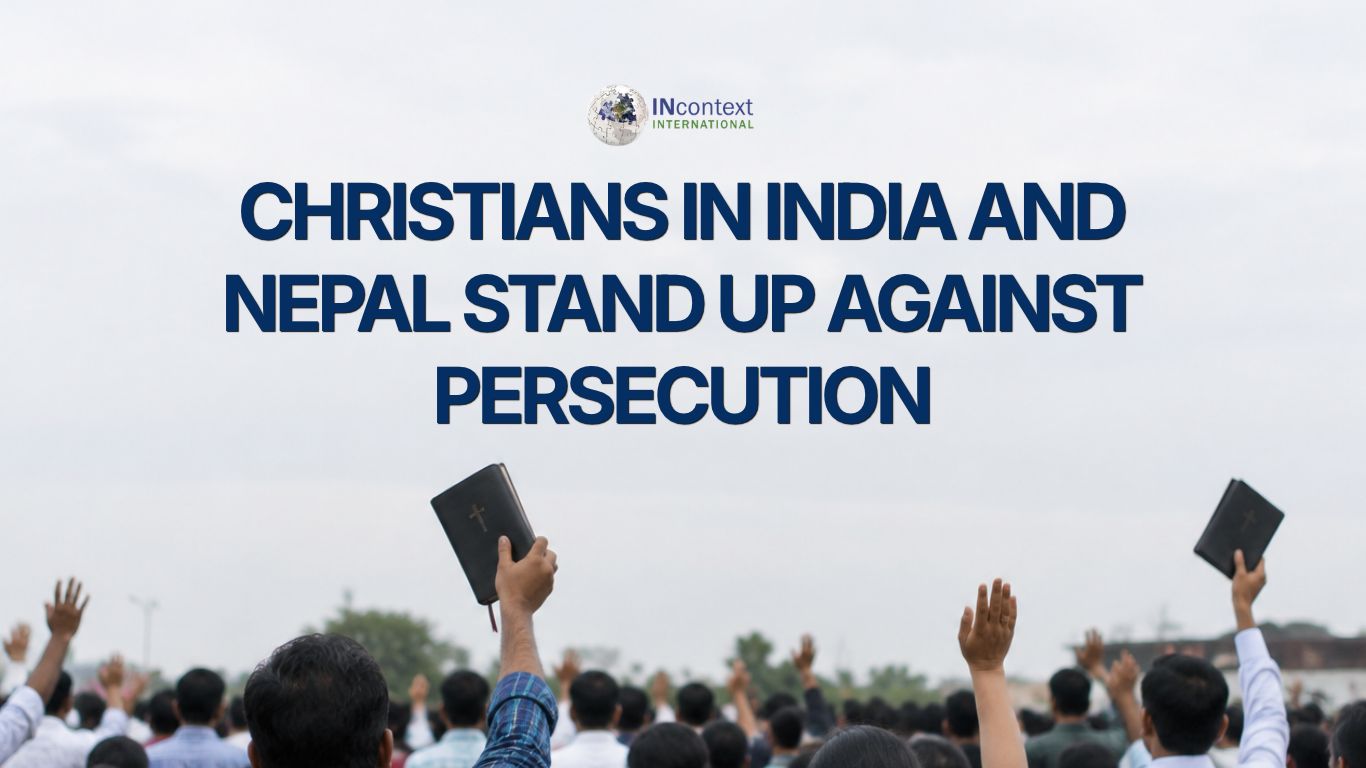
Religious freedom is coming under increasing pressure in parts of South Asia. In India, Hindu nationalist groups continue to target Christian communities, while in Nepal, recent government action has raised concerns about restrictions on religious freedom and the treatment of Christians and foreign missionaries. Although the circumstances in the two countries differ, Christians in both are raising their voices against growing hostility and restrictions on their constitutional rights.
On 5 November, Christian communities and inter-denominational organisations held major prayer and protest rallies in Nepal and India, calling for an end to targeted violence, intimidation and rising hostility.
Nepal
Nepal was once among the world’s 20 fastest-growing church movements, but growth has slowed in recent years. One significant factor is the anti-conversion legislation introduced in 2017, which prohibits converting, or attempting to convert, someone from one religion to another. Those found guilty can face imprisonment. Since the new government came to power in March this year, concerns about discrimination against Christians have also increased. This past year, hostility has increased to such an extent that Nepal has re-entered Open Doors’ World Watch List after three years, ranking 46th among countries where Christians face the most severe persecution.
A rally held in Kathmandu on 5 November was organised by the United Civic Party (UCP), a Christian-based political party, and attracted representatives from different Christian denominations. Bidur Adhikari, a UCP leader, said Christians were living in fear of worsening religious restrictions and a lack of government commitment to upholding constitutional rights to freedom of religion or belief.
He added that nearly three dozen foreign Christian missionaries, including volunteers, medical professionals and tourists, had been detained and deported over the past two months after radical Hindu groups accused them of illegal missionary activities.
The situation is complicated by the government’s efforts to address corruption and regulate foreign activity. Recent flooding in northern Nepal has highlighted the urgent need for relief work, but foreigners face restrictions when trying to assist affected communities. A friend of INcontext who has lived in the country explains:
“If you are on a tourist visa and help in relief work, you are taking a huge risk. My perspective is that the government is first trying to combat unlawful visas that were obtained during the previous government’s tenure, where bribes were the order of the day. There has also been a crackdown on government officials involved in corruption, both in the current government and from the previous administration.
“However, we experience that the government leans towards Hinduism and has been extremely focused on Christians, much more than on any other religion. Christians have been deported weekly in the past few months. They are definitely moving closer to Modi’s government, which persecutes Christians and Christian churches.”
Nevertheless, a survey conducted in 2022 by the Nepal Christian Society found that churches are now present in all 77 districts of the country. In a nation with more than 200 unreached people groups, according to Joshua Project, this is an encouraging foundation from which to continue taking the Gospel to communities that have yet to hear it.
Our friend adds: “It is important for us to pray! We can see that the time for Jesus’ return is drawing near as the world is suffering greatly because of natural disasters. There is an urgency for us to spread the Kingdom wherever we are.”
India
On 5 November, more than 12,000 people gathered in Kolkata, in the Indian state of West Bengal, to protest increasing hostility towards Christians. Compared with the 2,000 people who protested in Delhi the previous year, the turnout reflects the growing frustration among Christians who feel marginalised and unheard. They continue to call for justice, religious freedom and equal protection under the Constitution.
The event was organised by the inter-denominational organisation Bangiya Christiya Pariseba. Participants called for an end to anti-Christian violence and intimidation, and greater accountability for attacks on churches and prayer gatherings. Reference was made to the assault on the Santhali Bible convention in West Bengal on 9 October, where 2,000 people had gathered legally for a prayer convention. A group of approximately 200 people disrupted the convention, assaulting participants and vandalising the property.
India has more than 29 million Christians, representing approximately 2% of its population of just under 1.5 billion. Hindus make up close to 80%. Hindu nationalist groups have increasingly been accused of taking the law into their own hands, with attacks on Christians and their places of worship resulting in mob violence. Small house churches and informal prayer meetings are particularly vulnerable.
Panchugopal Mandal, a Christian from Balichak in West Midnapore district, who took part in the demonstrations, alleged that people attacked his house during his mother’s burial ceremony on 30 September. He accused local authorities of failing to respond adequately to his complaints.
The Kolkata rally followed a people’s tribunal on 2 November, where Christians from several districts testified about alleged attacks, intimidation and police inaction.
Another friend of INcontext who lives in India says, “There is persecution in all areas, but the city differs a lot from the rural areas. In the city, the Christians are better informed, and some churches have lawyers who can assist when things get difficult. Believers experience huge obstacles when they want to build churches or own property, for instance.
“It is also much safer to hold church services in registered properties rather than unregistered places. Hindu nationalists form mobs who come in and disrupt Christian activities. We were in a baptism service recently where that happened. They can disrupt, attack and lay charges against the people. The government or police do not stop or fine these attackers.
“In some areas, Christians do not experience pressure every day, but they are very aware that attacks or discrimination can happen any day. It is obviously very difficult for new people to come to faith.”
Despite the growing challenges, the Church in both countries continues to witness, worship and grow. Believers are asking for the freedom to practise their faith without fear, while continuing to share the hope of the Gospel.
Please join us in prayer:
- Please pray for protection, courage and perseverance for Christians in India and Nepal.
- Pray that the Church in Nepal and India will continue to grow in truth, discipleship and spiritual maturity.
- Pray that those in positions of authority will uphold the religious freedoms guaranteed by their constitutions.