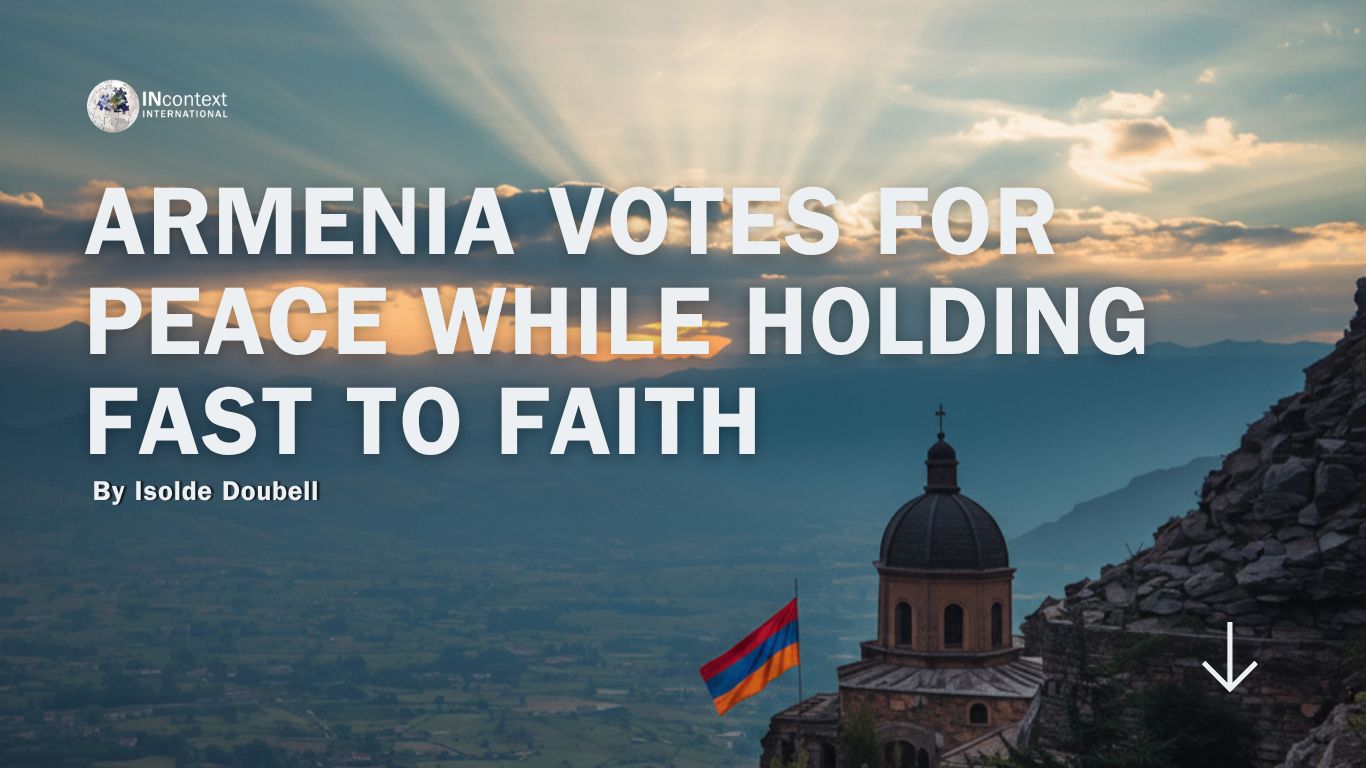
ARMENIA VOTES FOR PEACE WHILE HOLDING FAST TO FAITH
By Isolde Doubell
Armenia at a Crossroads
Armenia’s recent election has revealed a nation ready to make some changes towards peace and stability, while carrying the weight of a difficult past. In the 7 June election, voters in the small South Caucasus country of 2.89 million people gave a strong mandate to Prime Minister Nikol Pashinyan to pursue closer ties with Europe, improved relations with neighbouring Turkey and Azerbaijan, and a reduced reliance on Russia.
Bordered by Georgia and the Muslim nations of Azerbaijan, Iran and Turkey, the Christian nation of Armenia has long found itself at the centre of competing regional interests. Both Armenia and Azerbaijan were part of the former Soviet Union, and Russia has been playing a major role in the politics of both countries. However, many Armenians felt abandoned when Russia failed to intervene during the 2023 conflict in Nagorno-Karabakh despite having peacekeeping forces in the region.
The conflict over Artsakh, the Armenian name for the region of Nagorno-Karabakh, has left deep scars on Armenian society. The region, situated in Azerbaijani territory, was predominantly Armenian, but Joseph Stalin annexed Artsakh to the Soviet Republic of Azerbaijan in 1923 despite opposition from local Armenians who sought reunification with Armenia. The dispute continued after the collapse of the Soviet Union and erupted into repeated conflicts. Following a 44-day war in 2020, Azerbaijan gained control of around 70% of the land in and around Artsakh. Beginning in December 2022, Azerbaijan imposed a 10-month blockade on resources to the remaining Armenian-controlled territory before taking full control in September 2023.
The result was the displacement of more than 120,000 Armenians. Marina Simonyan, a legal professional and human rights advocate, described the experience: “We didn’t have any other choice. We had to leave our homeland. We had to leave our history of thousands of years, everything we had, our churches, our graveyards, our history, our memory, everything. We had to leave Artsakh.”
The challenges facing Artsakh refugees remain significant. Although many hold Armenian passports, they are classified as refugees rather than Armenian citizens. Only around 20,000 refugees are registered as workers, and most work in low-wage positions. Many refugees struggle to find housing because they are reluctant to give up their Artsakh passport for fear of not being able to return to their homeland.
A peace agreement signed between Armenia and Azerbaijan at the White House in August 2025 offers hope for greater regional stability. Although many details still need to be finalized, the agreement satisfies Azerbaijan’s demand for a 20-mile transport corridor through southern Armenia linking Azerbaijan and Turkey that would be managed by the United States. Several major pipelines carry significant amounts of oil and natural gas to and through Turkey, making Azerbaijan a critical economic partner for Europe, especially in light of tensions over Russia’s war in Ukraine. However, the deal doesn’t include a right to return for Artsakh refugees, nor the release of nearly two dozen Artsakh Armenians held captive in Azerbaijan’s capital, Baku.
The Armenian legacy
Yet politics is only part of Armenia’s story. Armenia became the first nation to adopt Christianity as its state religion in 301 AD and remains one of the oldest Christian nations in the world. The Armenian Constitution recognises the Armenian Apostolic Church “as a national Church”, although church and state are legally separate. Today, approximately 92% of Armenians identify as Christian. Most belong to the Armenian Apostolic Church (AAC), while Evangelicals account for around 9.3% of the population.
Armenia’s Christian identity has been forged through centuries of suffering. During World War I, up to 1.2 million Armenians were killed by the Ottoman Empire through massacres, individual killings and systematic mistreatment. This Armenian Genocide also displaced hundreds of thousands of Armenians across the globe and remains a defining chapter in the nation’s history. It remains deeply significant and is compounded by the recent displacement of the Artsakh Armenians.
Faith as a Backbone
A 2025 report by International Christian Concern documented the hardship and resilience of Armenia’s displaced Christian population nearly two years after the fall of Artsakh. According to the report, the exodus “has left an entire generation displaced, grieving, and searching for belonging”. The report also noted that numerous churches, cemeteries and Christian heritage sites were destroyed following Azerbaijan’s takeover. Despite these losses, the report documents Armenia’s deep resilience. “Faith remains the backbone of Armenian identity”, while one displaced mother captured the attitude of many refugees when she said, “We have lost everything but our faith.”
Churches and schools have become centres of healing and support, helping families rebuild their lives while offering spiritual care, education and hope to children. The report concluded with a call to the international community not to forget the people of Artsakh, stating: “The suffering of Artsakh’s people must not be forgotten. Their story is not only about loss — it is about faith, endurance, and the belief that God has preserved Armenia through every trial.”
Prime Minister reciting Psalms
Alongside political change, many Christian leaders see fresh opportunities for the Gospel in Armenia. According to Johannes Reimer, Professor Emeritus at the University of South Africa and co-founder of the Caucasus Mission, a landmark moment came in November 2025 when Evangelical Christians organised the first National Prayer Breakfast. It was hosted by the Peace and Reconciliation Network of the World Evangelical Alliance and attracted more than 300 participants from across Armenia, including Prime Minister Pashinyan and members of his cabinet.
Participants were encouraged by the Prime Minister’s open expression of faith. He recited entire Psalms from memory and repeatedly emphasised how important it is for him that his country be fundamentally oriented towards God and Christian values. Among other things, he said: “We often talk and constantly discuss, thinking about what additional mechanisms we should introduce to ensure good conduct, because good conduct is perhaps one of the most important issues in all countries. And, of course, good conduct is a topic of reforms, good conduct is a topic of regulations, checks and balances, but good conduct is not possible without the presence of God, good conduct is not possible without the Word of God.”
Pashinyan also expressed his hope that events of this kind would contribute to peace and prosperity in his country and that he thinks “the path of peace is the path God leads us through”.
Encouraging signs of evangelical growth can also be seen through ministries such as Young Life Armenia. In just a few years, the youth movement has introduced thousands of young people to faith in Christ and connected many of them to local churches. The ministry has even begun sending missionaries to neighbouring Turkey.
Challenges remain. Evangelical leaders continue to emphasise the need for greater unity and stronger theological education. Encouragingly, after the breakfast, discussions are underway about forming a national evangelical alliance and establishing an interdenominational evangelical seminary in the capital of Yerevan.
Please join us in prayer:
- Pray for Prime Minister Pashinyan and his government to walk in wisdom, faith and obedience to God.
- Pray for Armenia’s relationship with Russia and Azerbaijan — that the peace agreement will hold and that the Russians will not be able to economically force Armenia away from European partnerships.
- Pray for the displaced people of Artsakh — to forgive, to heal emotionally and to be able to build new lives in Armenia; also pray for the release of nearly two dozen Artsakh Armenians still held in Azerbaijan.
- Pray for the evangelical Church in Armenia — to continue to grow and make an impact for God’s glory.
Sources:
https://evangelicalfocus.com/european-perspectives/33286/armenia-the-hour-of-the-evangelical-church
https://www.hart-uk.org/a-short-history-of-nagorno-karabakh-artsakh/