By Sharon Higgins
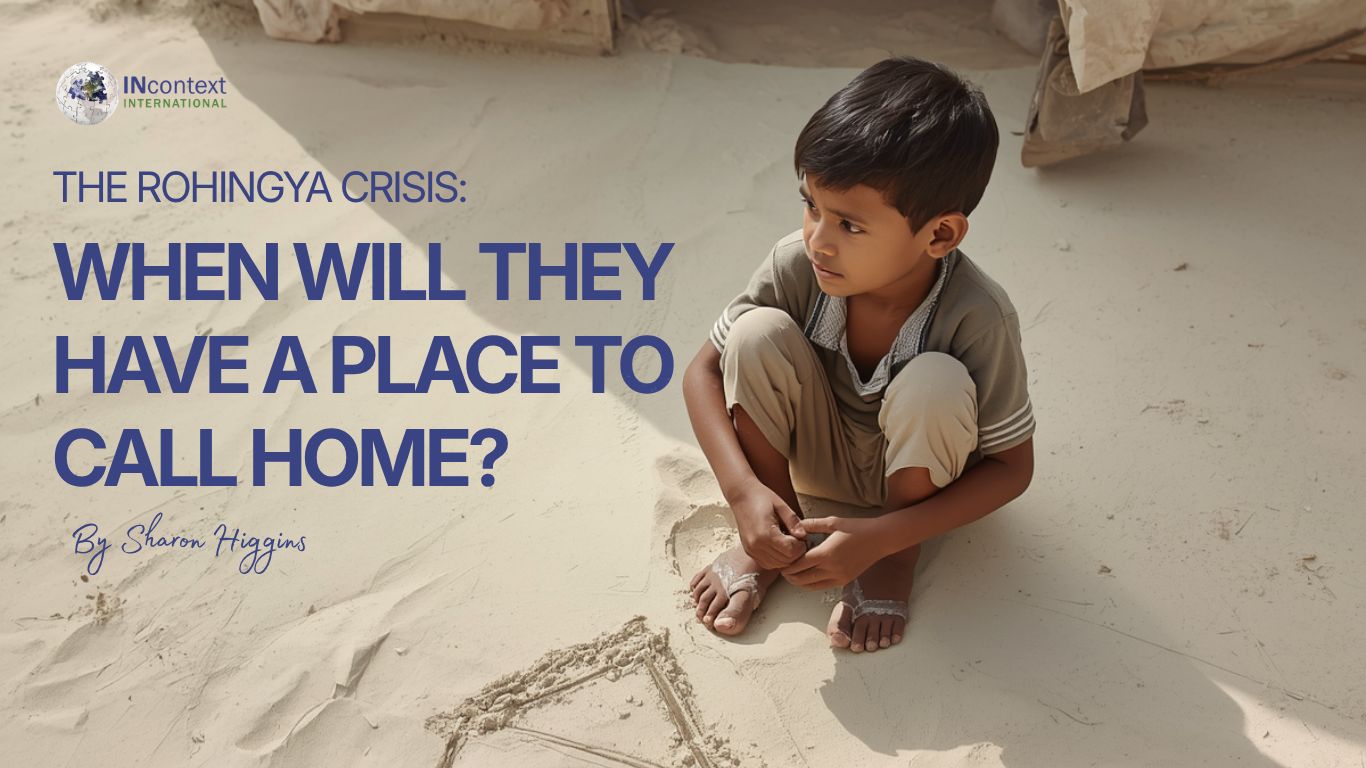
Nine years after hundreds of thousands of Rohingya fled Myanmar, the question remains painfully simple: When will they have a place to call home?
In 2017, more than 700,000 Rohingya fled Myanmar following a military crackdown in Rakhine State and sought refuge in neighbouring Bangladesh. Nearly nine years later, more than 1.2 million Rohingya refugees are living in Bangladesh, many in overcrowded camps where access to food, healthcare, education and livelihoods remains severely limited. Around 150,000 additional Rohingya have reportedly arrived since early 2024, fleeing renewed violence in Myanmar.
The crisis has become a long-running humanitarian emergency, but its prolonged nature can make it easier for the world to look away. The headlines have faded, yet the suffering has not.
A Home They Cannot Safely Return To
There have been renewed discussions about repatriation, but returning to Myanmar remains extremely difficult. Bangladesh submitted 828,824 names to Myanmar for verification. Myanmar has confirmed 308,797 people as former residents of Rakhine State and therefore potentially eligible to return. However, more than 113,000 could not be verified, while another 4,241 were flagged by Myanmar over alleged links to terrorism. Myanmar says that repatriation can only begin once security conditions in Rakhine State improve.
Previous repatriation attempts in 2018 and 2019 resulted in no Rohingya returning. Today, the situation in Rakhine remains unstable because of the continuing conflict between Myanmar’s military and the Arakan Army.
This is an important reality to understand: repatriation is not simply a matter of opening a border and sending refugees home. For a return to be safe and sustainable, the Rohingya need security, dignity, citizenship and protection from renewed violence. Without a comprehensive political and humanitarian settlement, many remain trapped between a homeland they cannot safely return to and refugee camps where their future is uncertain.
The wider conflict in Myanmar makes the situation even more complex. Since the military coup of February 2021, more than five million people have been displaced across the country, according to humanitarian and conflict assessments shared with INcontext. More than 15,000 civilians have reportedly been killed by the military in the years since the coup, while civilians continue to face airstrikes, displacement, food shortages and the destruction of homes, schools and places of worship.
Open Doors ranks Myanmar 14th on the 2026 World Watch List, placing it among the countries where Christians face very high levels of persecution. Open Doors reports that Christians in Myanmar continue to suffer because of both persecution and the wider conflict, with Believers displaced and churches and Christian communities affected by violence.
A People Still Waiting
The Rohingya are not simply a statistic in a refugee report. They are fathers and mothers, children and grandparents, students and workers – people made in the image of God.
The Joshua Project identifies the Rohingya as a frontier unreached people group. Its data estimates hundreds of thousands of Rohingya in Myanmar and around 895,000 in Bangladesh, with the group recorded as having virtually no Evangelical or Christian presence.
This should matter deeply to the Church.
Jesus repeatedly demonstrated God’s concern for people who were vulnerable, displaced, overlooked and excluded. In Matthew 25:35, He says, “I was a stranger and you invited me in.” His words challenge us to see displaced people not as a political problem or an inconvenient statistic, but as human beings deserving dignity, compassion and practical love.
Scripture also reminds us that God sees those whom the world may overlook. Psalm 34:18 declares, “The Lord is close to the brokenhearted and saves those who are crushed in spirit.”
The Rohingya crisis may have disappeared from many news cycles, but it has not disappeared from God’s sight.
The Church in a Forgotten Crisis
We need to ask ourselves, how, then, should Christians respond?
The Church’s calling is not limited to speaking about crises when they are prominent. We are called to remember, pray, serve and love consistently.
Faith-based organisations and local communities have an important role to play throughout Myanmar. In conflict-affected areas, churches and other faith communities are often deeply embedded within local networks and are able to reach people who are inaccessible to international organisations. They provide food, shelter, education, medical assistance, pastoral care and spiritual encouragement.
For displaced communities, this kind of presence can be profoundly significant. People need more than physical survival; they need hope, dignity and the assurance that they have not been abandoned.
This is where the Church can become a light in a dark situation. Galatians 6:2 tells us, “Carry each other’s burdens, and in this way you will fulfil the law of Christ.”
For Christians, carrying the burdens of the Rohingya means praying for them, supporting trustworthy organisations serving displaced communities and asking God for wisdom about how we can respond. It also means refusing to allow compassion fatigue to make us indifferent.
A People Who Need Justice and Hope
The future of the Rohingya cannot be separated from the future of Myanmar itself. The country’s continuing conflict has created enormous humanitarian needs, while women, children and minority communities remain particularly vulnerable.
There are no easy answers. Peace requires justice, reconciliation, security and a willingness to address the deep political and ethnic divisions that have fuelled Myanmar’s conflicts for decades.
Yet Christians believe that reconciliation is ultimately rooted in the character of God. Micah 6:8 calls God’s people to “act justly and to love mercy and to walk humbly with your God.” These are not merely private virtues; they should shape how the Church responds to suffering and injustice.
The Rohingya crisis also presents an opportunity for the global Church to ask difficult questions: Are we willing to remember people after the headlines disappear? Are we willing to serve when there is no recognition or reward? Are we willing to pray for people whose circumstances may seem impossibly complicated?
And perhaps most importantly, are we willing to ask God how He wants His Church to be present?
When will They Have a Place to Call Home?
For the Rohingya, home remains out of reach.
Nearly 309,000 people have now been verified by Myanmar as potentially eligible for repatriation, yet security concerns continue to delay their return. At the same time, more Rohingya continue to flee renewed violence, while humanitarian funding for the refugee response is under severe pressure. A 2026 UN appeal for basic services in Bangladesh had received only around 60% of the requested funding when the UN warned that further cuts could dramatically worsen conditions for approximately 1.2 million refugees.
The Church must not forget them.
We can pray for a just and lasting resolution to Myanmar’s conflicts, for the protection and dignity of the Rohingya, and for wisdom for those working towards peace. We can pray for local churches and faith-based organisations serving displaced communities. We can pray that God will open doors for the Gospel among the Rohingya, an unreached people with almost no Christian presence.
And we can pray that, in the midst of displacement and uncertainty, the Rohingya will encounter the God who sees them.
“He will defend the afflicted among the people and save the children of the needy.” — Psalm 72:4
The Rohingya may still be waiting for a place to call home, but they are not forgotten by God. May the global Church refuse to forget them too.
Please join us in prayer:
- Pray for the Rohingya, that God would protect families living in refugee camps and provide food, shelter, healthcare, education and hope for those who have been displaced.
- Pray for justice and a lasting peace in Myanmar, asking God to bring an end to violence, protect civilians and open the way for a safe, dignified and sustainable future for displaced communities.
- Pray for the Church and Christian organisations serving Myanmar and Bangladesh, that God would give them wisdom, courage and practical opportunities to be His hands and feet among vulnerable communities.
- Pray for the Rohingya to encounter Jesus Christ. Joshua Project identifies the Rohingya as a frontier unreached people group; ask God to open doors for the Gospel, raise up workers and reveal His love to a people who have endured immense suffering.
- Pray that the international community will not forget Myanmar and the Rohingya crisis. Ask God to move governments, organisations and individuals to respond with compassion, justice and perseverance, rather than allowing this crisis to disappear from view.
Sources
https://apnews.com/article/myanmar-rohingya-repatriation-rakhine89fcdccc35af7126d62ea7331fa8fdbb
https://www.sekbernews.id/en/myanmar-verifies-displaced-rohingya-repatriation
https://joshuaproject.net/people_groups/11359/BM
https://m.joshuaproject.net/unreached/7?o=asc&page=68&s=PrimaryReligion
https://www.opendoors.org.za/world-watch-list-2026
https://www.opendoorsuk.org/persecution/world-watch-list/myanmar
https://opendoors.fi/wp-content/wwl2026-5McnsjV9vC/OD-WWL-2026-Top50
https://www.opendoors.org.za/christian-persecution/world-watch-list/myanmar